TiCDC resolved-ts lag spikes: incremental scan stuck due to slow disk
A real-world incident where slow TiCDC disk IO (Unified Sorter spill-to-disk) caused backpressure, stalled TiKV incremental scan, and drove Changefeed resolved ts lag up.
1. Symptoms
You can think of resolved-ts as a global watermark from TiKV to TiCDC. If it cannot advance in time, it impacts both the changefeed checkpoint and downstream consumption progress.
- A changefeed/table
resolved-tsis essentially the minimum resolved-ts across all Regions that are being replicated - If some Regions stay in CDC initialization not finished (TiKV incremental scan / initial scan not completed) for a long time, TiCDC won’t advance those Regions’ resolved-ts
- The slowest Region’s resolved-ts is stuck → the global resolved-ts is stuck →
resolved ts lagkeeps increasing over time (often “linear growth”) resolved ts lagis also a lower bound forcheckpoint ts lag, so checkpoint lag can keep increasing as well

Typical business impact: downstream (MQ / MySQL / other sinks) consumption latency increases and triggers SLA alerts.
2. Quick diagnosis
-
Besides seeing changefeed resolved ts lag growing linearly, the incremental scan speed is also very slow.
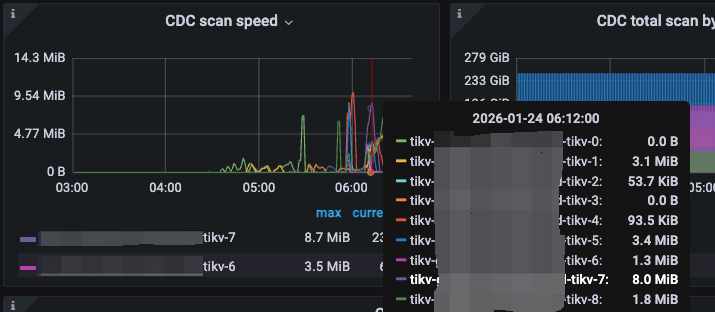
-
unresolved region countmay stay non-zero for a long time and cannot drop to 0.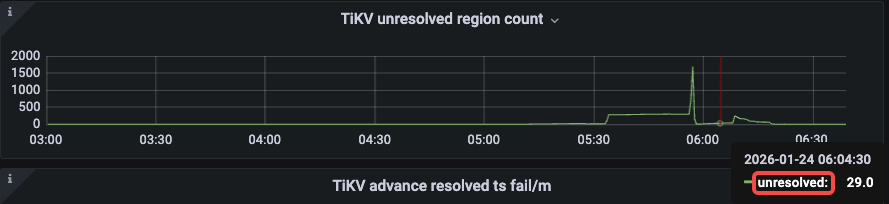
-
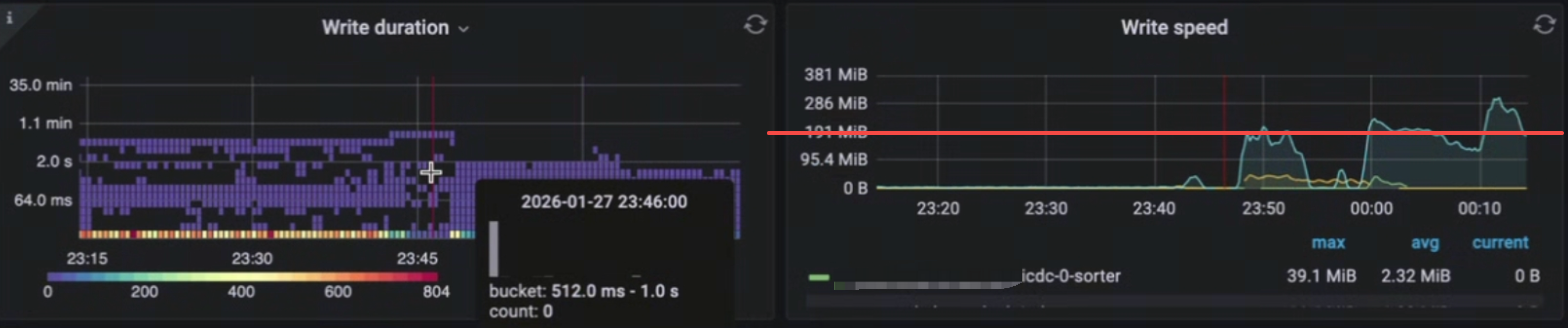
When backlog is obvious (resolved-ts lag), disk write throughput should usually be high, but the actual write throughput is low (e.g. write speed < 50MB/s).

-
From experience: if TiCDC itself has no obvious bottleneck and the TiKV cluster is large enough, aggregate incremental scan throughput (all TiKVs together) can reach ~200GB/s. Compared to that, the observed write throughput is clearly too low.
3. Quick mitigation
If you don’t replace it with a higher performance disk, it won’t get better.
4. Full resolution
- Move TiCDC’s data directory to a high-performance disk (higher IOPS, lower latency, e.g. local NVMe / high-end SSD)
- See the official recommendation: 500 GB+ SSD
- After upgrading the disk, you should observe write speed reaching ~200MB/s
5. Root-cause chain
5.1 Summary
TiCDC’s Unified Sorter is disk-heavy. When TiCDC disk performance is insufficient, slower spill-to-disk triggers TiCDC flow control/backpressure, which slows down TiKV incremental scan sending. The incremental scan can’t finish in time, and resolved-ts lag rises abnormally.
5.2 Detailed mechanism
- A slow sorter blocks the processing path such as
engine.Add(...), so the puller consumes more slowly - Upstream KV client / region worker channel
regionWorkerInputChanSizegets filled and blocks, so gRPC Recv slows down - gRPC flow control/backpressure propagates back to TiKV, so TiKV blocks when sending scan events at
send_all(...).await - The incremental scan can’t finish in time, and the
INITIALIZEDevent cannot be received/processed by TiCDC - The Region is still treated as “not initialized” → TiCDC doesn’t advance that Region’s resolved-ts → the global watermark is pinned by the slowest Region → resolved-ts lag grows linearly
5.3 Visualization
flowchart TB
  %% Data path: TiKV -> TiCDC -> sorter/sink
  subgraph TiKV["TiKV"]
    tikv_scan["CDC initializer<br/>incremental scan loop"]
    tikv_send["CDC gRPC send<br/>sink.send_all await"]
    tikv_scan -->|scan batch to events| tikv_send
  end

  subgraph TiCDC["TiCDC TiFlow"]
    cdc_recv["KV client receive<br/>shared_stream.receive Recv"]
    region_worker["KV client region worker<br/>inputCh=32 sendEvent"]
    puller["Puller<br/>inputCh=1024 runEventHandler"]
    sorter["Sort engine<br/>engine.Add unified pebble"]
    sink["Sink / redo / downstream<br/>disk IO heavy"]
  end

  tikv_send -->|gRPC stream ChangeDataEvents| cdc_recv
  cdc_recv -->|dispatch| region_worker
  region_worker -->|emit to eventCh| puller
  puller -->|consume to engine.Add| sorter
  sorter -->|flush compaction write| sink

  %% Backpressure / flow control: downstream slow -> upstream blocks (where it happens)
  sink -.->|disk slow write flush blocks| sorter
  sorter -.->|engine.Add blocks| puller
  puller -.->|inputCh fills emit blocks| region_worker
  region_worker -.->|inputCh fills sendEvent blocks| cdc_recv
  cdc_recv -.->|Recv slow gRPC flow control| tikv_send
  tikv_send -.->|send_all waits scan loop stalls| tikv_scan